
Aesthetics & Skin
What makes a facial worth booking twice
Any facial feels nice for an afternoon. The question is whether anything changed by Thursday. A medical-grade facial is built for the second answer, and you can tell the difference before you pay.
Every price, on the page
Pricing
Our facial menu, priced on the page
No PDFs, no "call for pricing," no menu you only see once you're in the chair.
- The Helix HydraFacial$189
The Signature protocol done right. About 30–45 minutes, no downtime. The perfect first HydraFacial, or the monthly reset for skin that's already in good shape.
- Helix Deluxe HydraFacial$249
Everything in the Signature, plus a targeted booster serum, red-light therapy, and a Jan Marini medical-grade finish. About 45–60 minutes. This is the one most of our clients settle into.
- Helix Platinum HydraFacial$329
Our most complete treatment. Everything in the Deluxe, plus dermaplaning, lymphatic drainage, extended extractions, and an exosome infusion. Roughly 75–90 minutes.
- Jan Marini Go & Glow Facial$149
- Clarify Peel (Acne & Congestion)$149
45 min.
- Refine Peel (Texture & Tone)$179
45 min.
- Transformation Peel (Advanced Anti-Aging)$229
45 min.
- Dermaplaning$99
DermaFlash Pro.
CO2Lift® Carboxy Mask
Carboxytherapy without needles — visibly plumper, brighter, deeply hydrated skin in one 45-minute session. Gentle enough for the eyelids and under-eyes. No downtime.
- CO2Lift in clinic$125
On its own, or before an event.
- CO2Lift added to any treatment$89
Added to a facial, laser or peel to calm redness and speed healing.
- CO2Lift take-home 3-pack$299
Financing is available through Cherry and CareCredit. Individual results vary.
FAQ
Facial treatment — common questions
Is an expensive facial better than a cheap one?
Not inherently — but price does correlate with two things that matter: how long you're in the chair, and what's in the bottles. A rushed twenty-minute treatment with commodity product will always underperform a proper forty-five-minute protocol with medical-grade actives, and there's no way to fake that gap. What price does *not* buy you is the provider's judgement. That varies independently.
How can I tell if a facial did anything?
Check on day four, not day one. Everyone glows on day one — you just had your face massaged and hydrated. The real test is whether your skin still looks clearer, feels smoother, and takes makeup better by the middle of the following week. That's the difference between a surface effect and a treatment.
Do I really need red-light therapy at the end?
It's a reasonable finish to a resurfacing treatment, and we include it rather than sell it — which sidesteps the question entirely. Our position is that if something belongs in the protocol, it should be in the price, not offered to you mid-treatment while you're lying down with your eyes closed.
What should a good provider do differently?
Look at your face before touching it. Ask what's changed recently — new medication, new stress, new sleep pattern, new product. Adjust the device settings as they move across different zones. And say so when the thing you're worried about isn't a facial problem at all.
How many will it take?
One will look good. Three to four, spaced roughly a month apart, is where people usually notice their baseline has genuinely shifted — because that's a full skin-turnover cycle repeated a few times. We'd rather set that expectation than let you judge a treatment plan by its first appointment. Individual results vary.
The details
Facial treatment, in full
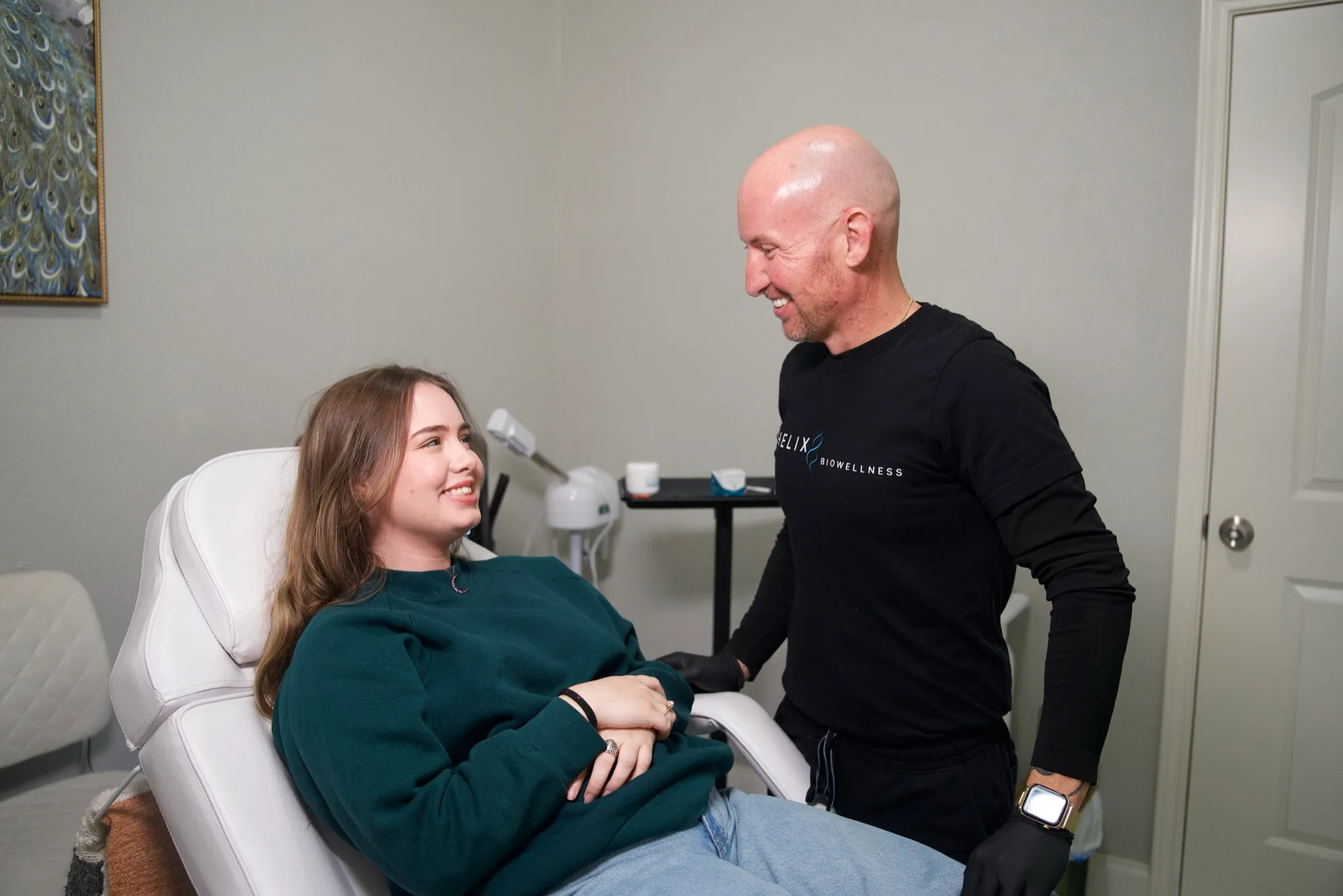
The Thursday test
Here’s the only honest way to evaluate a facial: forget how you look walking out. Everyone looks good walking out. You’ve just had your face steamed, massaged, and saturated. That glow is partly circulation and partly the fact that someone paid attention to you for forty-five minutes.
Look on Thursday. Four days later, in unflattering light. Is your skin clearer? Is the texture smoother? Does makeup sit differently? Did anything change, or did you just have a nice afternoon?
A lot of facials fail this test. Here’s what separates the ones that don’t.
1. The device is doing real work
There’s a category difference between a treatment where product is applied to your face and one where a device is actively changing your skin.
Our HydraFacial runs on the Syndeo, the newest generation of the platform. It’s not a marketing distinction — the handpiece lets a provider adjust suction and serum delivery in real time, zone by zone, so a congested T-zone and thin cheek skin get genuinely different treatments in the same forty-five minutes.
Extraction is the clearest example. Vacuum suction pulls congestion out of the pore. Fingernails push it around and leave you blotchy. Both are called “extraction.” Only one of them is.
2. The products are medical-grade, and they’re included
We use medical-grade products throughout, and every HydraFacial finishes with red-light therapy and Jan Marini finishing products — both included, neither an upsell.
That inclusion is a design decision, not a promotion. The most common way a facial gets diminished is that the things which would have made it work get unbundled and quoted to you separately, at the chair, at the moment you’re least equipped to evaluate them. We put the whole protocol in one number so nobody has to make a purchasing decision lying down with their eyes closed.
3. The provider looks at your face before touching it
This is the part no device replaces.
A good provider asks what’s changed — new medication, new stress, a new retinoid you started three weeks ago, the fact that you haven’t slept properly since spring. They watch how your skin responds during the treatment and adjust. And, critically, they’ll tell you when the thing you’re upset about isn’t a facial problem.
Because sometimes it isn’t. Texture and acne scarring want collagen remodeling — that’s SkinPen microneedling, not a better exfoliation. Pigment and redness want a wavelength aimed at them. And sometimes what’s showing up on your face is coming from somewhere else entirely.
4. Someone can follow the thread further than your skin
This is where a facial at a longevity practice differs from a facial at a facial bar, and it’s the argument we’d make for ourselves.
Helix Biowellness® is a physician-guided longevity clinic. The aesthetics room sits inside it, down the hall from functional lab testing, hormone work, and the biohacking suite. So when your skin has changed and nobody can tell you why — when it’s inflammation, or thyroid, or hormones, or sleep debt that’s finally showing — there is someone here who can go look.
Most places can make your face glow for an evening. Fewer can ask why it stopped glowing on its own.
5. The price is on the page
Ours are in the cards below. Every treatment, every number, no exceptions — not a package that hides the per-treatment cost, and nothing held back for the chair.
That’s the standard. Judge us by it.
Book below or call 409.498.5011.
Individual results vary.
Related at Helix